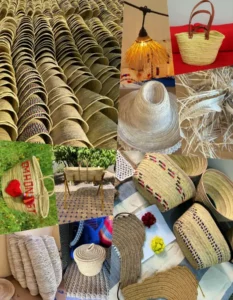
Product development · Fes · 2026
Raffia Bag Samples
- Craft
- Raffia
- Scale
- Sampling & prototyping
- Year
- 2026
Before a single raffia bag is woven, someone has to make the thing it will be woven around.
This is the step buyers rarely see. A new shape — a base width, a flare, a depth, a handle drop — cannot be woven freehand and then repeated reliably. It needs a gauge: a metal former, cut and bent to the exact dimensions of the design, that the weaver works against so the four-hundredth bag carries the same silhouette as the first.
In the film, that gauge is being made by hand. Rod stock is cut, worked against the anvil, bent and trued by eye until it answers the drawing. Only then does sampling begin.
We build the gauge in-house for every new shape, and we keep it. A repeat order comes off the same former, which is why it matches the original instead of approximating it — the usual complaint buyers have about handmade goods, and an avoidable one.
How sampling runs
- A drawing, a reference photo or a physical bag as the starting point
- Gauge fabricated to the agreed dimensions, then archived for re-orders
- First prototype woven in raffia or doum palm, then correction rounds until sign-off
- Colour, handle, lining and finishing all settled at sample stage, before production opens
Bring us a drawing, a sample, or an idea
We will tell you honestly whether it can be made by hand in Morocco, at what quality, and in what time. First sampling usually begins within two weeks.
Book a call